
Nobody Told Me Dinner Would Be the Hard Part
Feeding yourself with chronic illness
I know what your kitchen looks like at 5pm on a hard day. It’s always some version of the same story: standing in front of the open fridge, completely wiped out, staring at ingredients that require a version of you that left the building around 10am. And the worst part isn’t even being hungry. It’s that little voice that shows up right alongside the hunger and says: you should be able to handle this.
That voice has never had a flare. Ignore it. This isn’t a meal plan. It’s not a “healing foods” guide or an anti-inflammatory recipe roundup. It’s more of an honest conversation about what feeding yourself actually looks like when your body spent everything it had before noon and what to do about it on a day when you have almost nothing left.
 The Part Nobody Says Out Loud
The wellness world treats food like a solution. Eat this and feel better. Meal prep on Sundays! Thirty minutes or less! Fresh, wholesome, nourishing!
For us, food is also a problem. It requires standing. Gripping. Lifting things that are heavier than they look on a bad joint day. Timing multiple things at once when your brain fog has other plans. It asks for energy on the days you have none, so you can get energy back. The whole setup is absurd.
And then there’s the emotional layer on top of all of it. Feeling like you’re letting your family down. The grief, and I do mean grief, for the person you used to be who cooked actual meals and maybe even liked it.
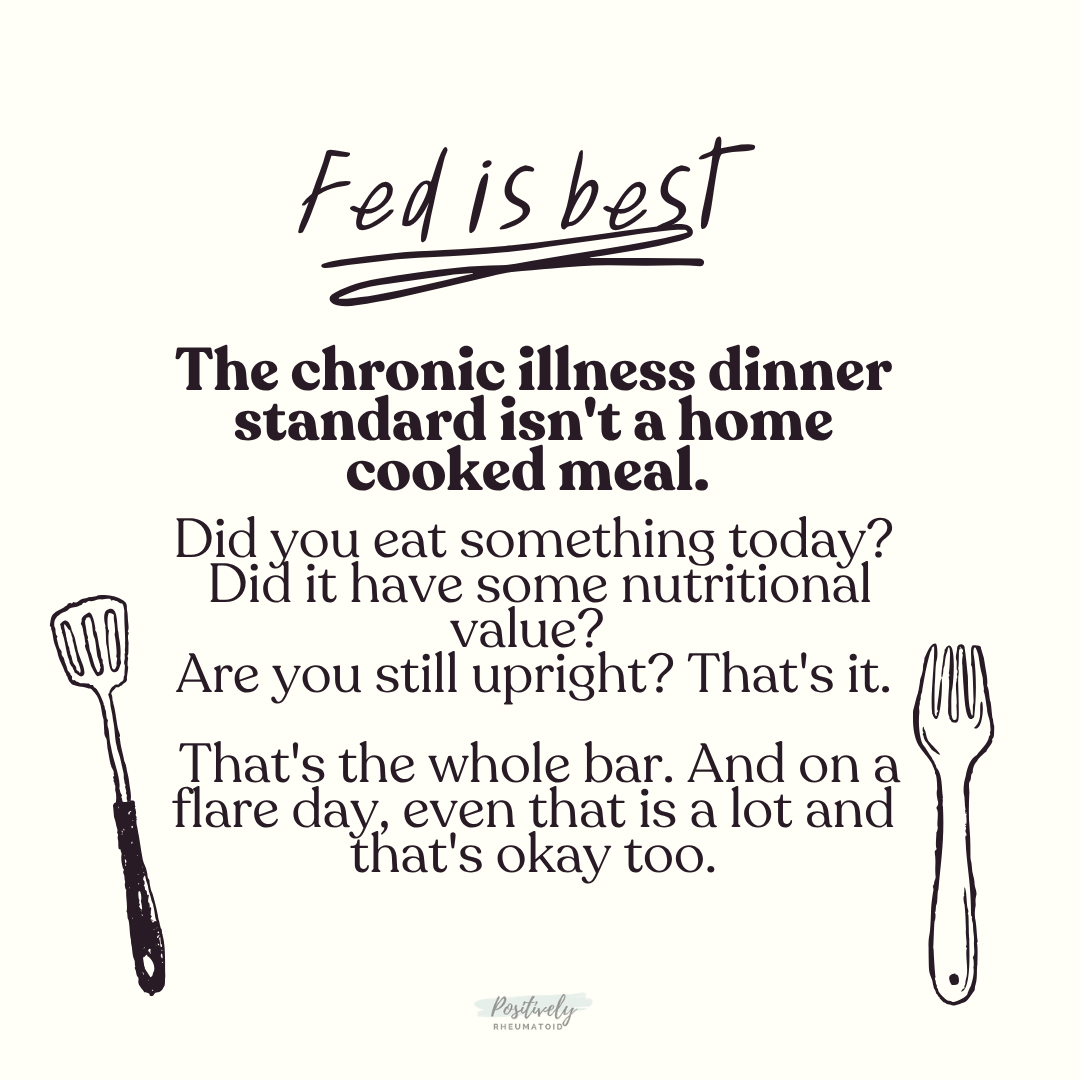
You are not failing at dinner. You are managing a chronic illness. Those are two completely different things.
 Two Kinds of Days. Two Completely Different Strategies.
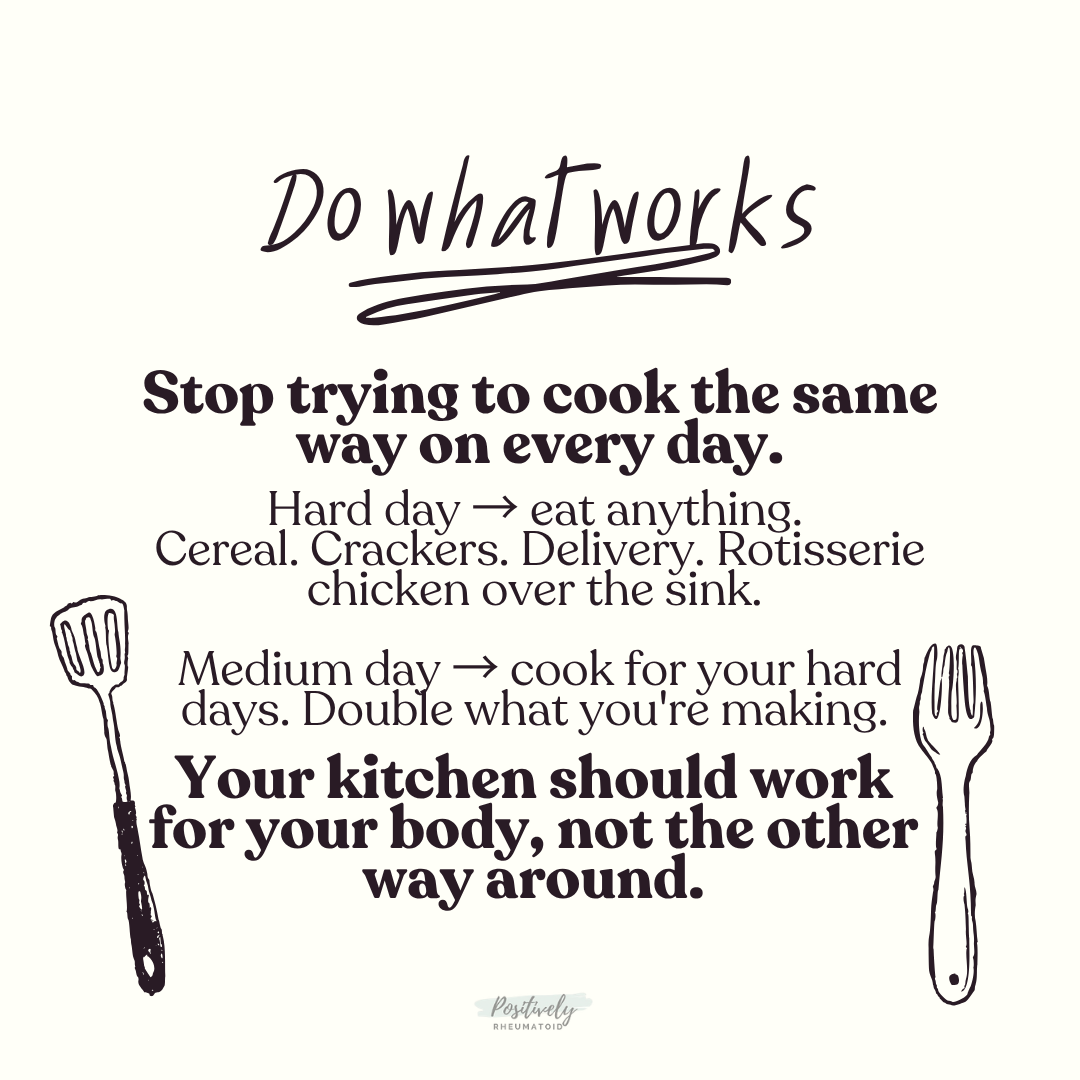
The thing that actually helped me was figuring out I needed a totally different approach depending on what my body was doing. Trying to apply the same plan to a flare day that I used on a “regular” day was how I ended up frustrated, exhausted, and eating nothing at 9pm because I’d been “planning to cook” since 4 oclock.
On the hard days
The goal is not a balanced meal. The goal is: food in body. Survival mode has one rule and it’s just, eat something.
- Cereal counts. Crackers and peanut butter count. Cheese straight from the package counts. I don’t make the rules, I just report them.
- Rotisserie chicken from the deli is not a shortcut. It’s a fully cooked protein that someone else made for you. That’s called a win.
- Delivery is a medical accommodation. On the days your body can’t stand at a stove, having food come to your door is problem solving. Not indulgence.
- The microwave does not judge you. Frozen meals, canned soup, last night’s leftovers, it handles all of it without a single comment about your choices.
On the medium days
Medium days aren’t for cooking something impressive. They’re for cooking for your hard days. When you have a little more in the tank: double whatever you’re already making. Throw something in the slow cooker before you sit down. Hard boil a batch of eggs. Stock your pantry back up. You’re not meal prepping. You’re leaving yourself a gift from a slightly better version of today.
 What “No Cook” Actually Means
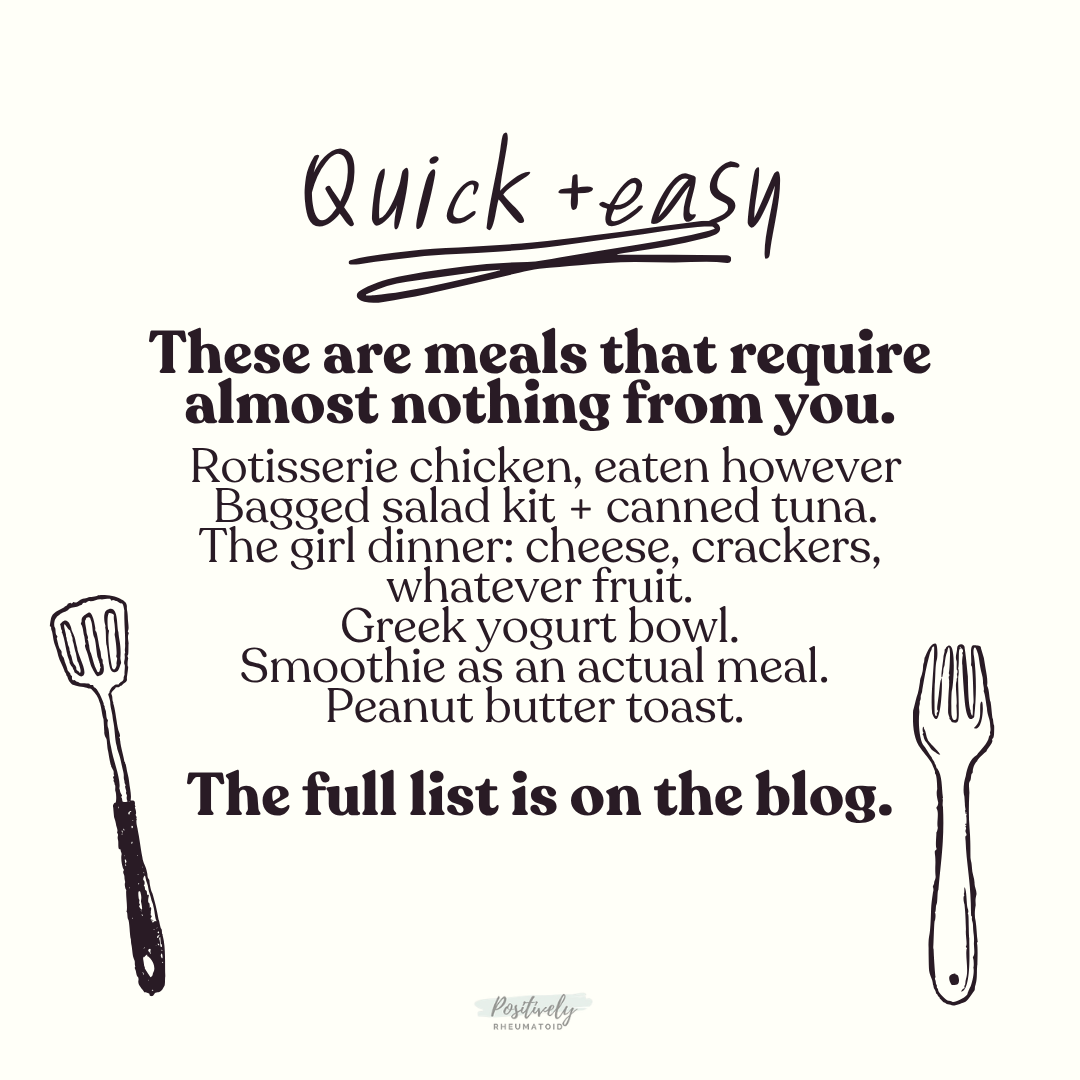
“Easy meals” content on the internet has a very loose definition of easy. These are things that require no heat, minimal grip, and can genuinely be done sitting down.
- The assembled plate: Cheese, crackers, deli meat, whatever fruit you have. Hummus if you’re feeling fancy. This is a charcuterie board with the pretension taken out. Four minutes, real food, done.
- Bagged salad kit + canned tuna: Pre-washed, pre-chopped, dressing already in the bag. Open a can of tuna or salmon. Combine. Your hands never touched a knife.
- The Greek yogurt situation: Yogurt, granola if you have it, whatever fruit is around. High protein, and the cold helps on nausea days more than people realize.
- Rotisserie chicken, eaten however: Pulled apart over the sink. On crackers. Cold, straight from the container at 7pm. There is truly no wrong way to do this.
- Smoothie as an actual meal: Frozen fruit, yogurt or protein powder, whatever liquid. Especially good on injection days when chewing feels like too much to ask.
- Peanut butter toast: Not glamorous. Completely legitimate. Does exactly what it needs to do.
The Grocery Store Has Already Done Half the Work. Use It.
The deli counter, the prepared foods section, the bagged produce aisle, all of it exists because other humans also don’t have unlimited time and energy. You are allowed to use these things. You are not cheating at anything.
Worth the extra cost when you’re managing a chronic illness:
- Pre-washed, pre-cut vegetables. Yes, they cost more. So does the flare you’d trigger standing at the cutting board for 20 minutes. Do the math for your body, not the grocery receipt.
- Pre-cooked grain pouches. Rice, quinoa, lentils. Microwave for 90 seconds. That’s the entire effort.
- Frozen everything. Already washed, already cut, already partially cooked.
On curbside and delivery: if walking a full grocery store while flaring costs you the rest of your day, the delivery fee isn’t a splurge.
When Your Medication Is Also Making Dinner Harder
Nausea. Metallic taste. Injection day appetite that basically doesn’t exist. Nobody puts this in the brochure.
Quick note: always check with your own doctor or pharmacist about what works with your specific medications. What’s here is just stuff that tends to help, not medical advice.
For nausea
Cold or room temp food is usually easier than hot, the smell of cooking is often the actual trigger, not the food itself. Bland, salty, or sour things tend to stay down better than rich ones. Crackers, pretzels, plain rice, ginger anything. Small amounts, more often. If three meals feels impossible, six small things is fine.
For metallic taste (looking at you, Methotrexate)
Plastic utensils actually help, this sounds weird but it makes a difference. Citrus and vinegar-based flavors can cut through it. Cold food has less of a metallic smell than hot food. Mint and ginger can temporarily knock it back. Honestly, this one takes some personal trial and error and that’s annoying, but you’ll find your thing.
For when you have no appetite at all
Go for small, calorie dense things you can eat in a few bites: nut butter, cheese, avocado, full-fat yogurt. Eat when the window opens even if it’s 3pm or 10pm or whatever weird time your body decides it’s okay. Keep something within arm’s reach so there’s no work when the moment arrives.
Low Spoons Doesn’t Have to Mean Expensive
Chronic illness is already expensive in ways that are genuinely hard to explain to people who don’t live it. Your grocery bill doesn’t need to add to that. Some cheap, low effort options that actually work:
- Eggs: Scrambled in a mug in the microwave. Fried in one pan. Hard boiled in a batch on a medium day. Cheap, fast, high protein.
- Canned beans: Rinse, heat, eat. Add hot sauce and cheese. Under a dollar a serving and genuinely filling.
- Oatmeal: Plain rolled oats, not the fancy flavored packets. Microwave, add a banana and peanut butter. That’s breakfast and it costs almost nothing.
- Frozen vegetables + rice + soy sauce: Three ingredients, one microwave, around $2 a serving.
- Pasta with butter and parmesan: Sometimes this is dinner. I like to use high protein pasta. This is one of my all time favorites.
- Rotisserie chicken: Usually $5-7 and gives you at least three meals. More cost effective than buying raw chicken once you factor in that you don’t have to cook it.
The Family Conversation about dinner
“Why can’t you just make something quick?”
If you’ve heard that one, I’m sorry. There is a particular kind of exhausting that comes from having to explain, again, why the thing that looks simple from the outside is not simple from inside your body. I’m not going to pretend there’s a perfect script for the bigger conversation. But for the kitchen specifically, a few things that actually help:
Get specific. “Can you help more with dinner?” is too vague. “Can you grab a rotisserie chicken on your way home?” gets done. Give people a clear task and most of them genuinely want to do it.
Make a no cook night an actual thing. Put it on the calendar. Wednesday is cereal night. Friday is fend-for-yourself night. Removing the decision on a hard day is sometimes worth more than any meal.
Name the invisible part. Even on the days you don’t cook, you’re still thinking about meals, tracking what’s in the house, managing the whole system in the background. That’s work.
Here’s the Actual Thing I Want You to Take From This
Not a shopping list. Not a meal plan. Just this: The bar for feeding yourself with a chronic illness is not the same bar as feeding yourself with a healthy body. And a lot of us have been quietly holding ourselves to the wrong standard for years.
Cereal for dinner is fine. Delivery on a Tuesday is fine. Cold rotisserie chicken eaten over the sink at 6:30pm while you’re still in the same clothes you wore yesterday is fine. All of it is fine. You fed yourself. You kept going. That’s genuinely the whole thing. Your kitchen doesn’t have to look like anyone else’s. It just has to work for the body you actually have.
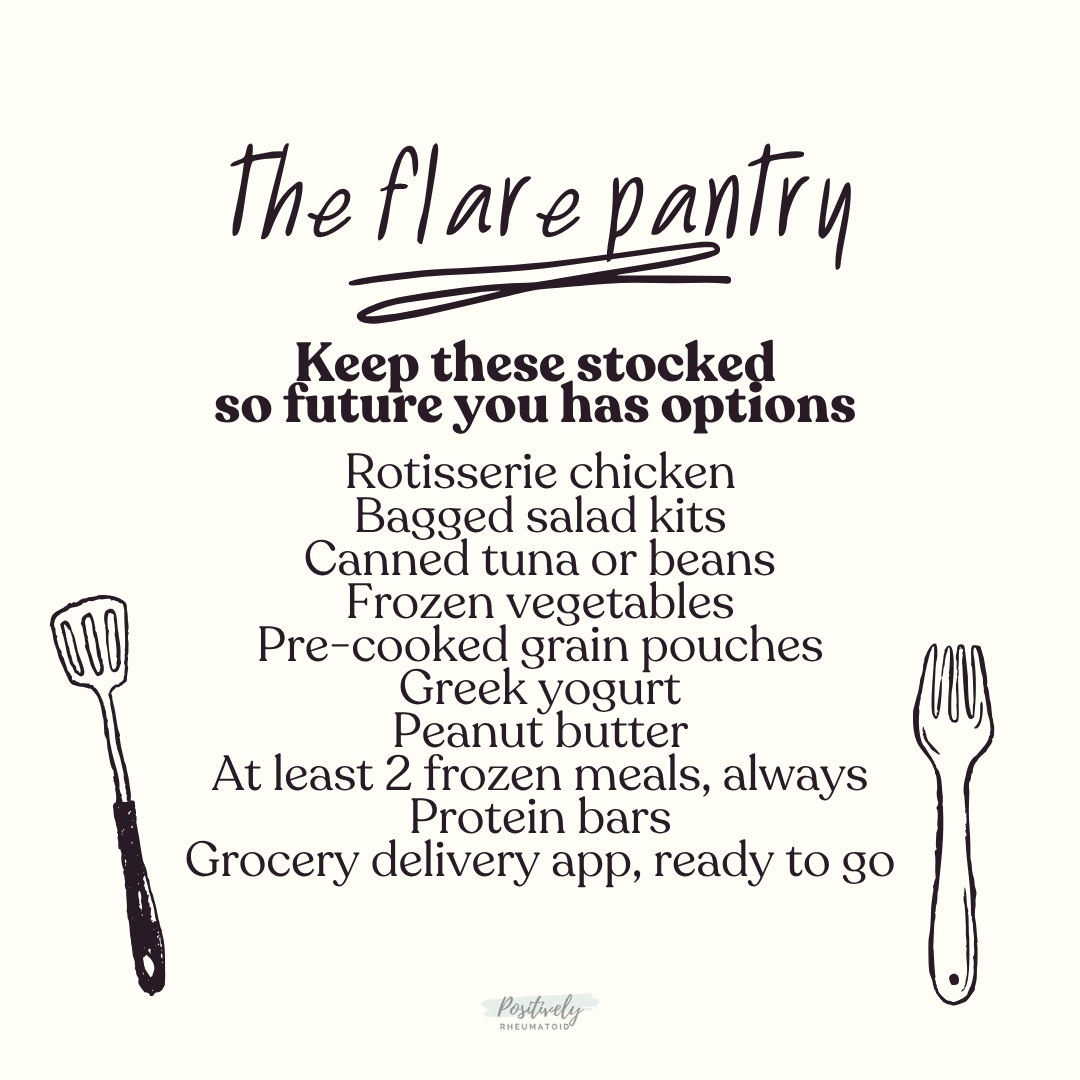
The Flare Pantry
The Flare Pantry: Keep These Stocked So Future You Has Options
- Rotisserie chicken
- Bagged salad kits
- Pre-cooked grain pouches
- Canned tuna, salmon, or beans
- Greek yogurt
- Peanut butter
- Crackers, rice cakes
- Frozen vegetables
- At least two frozen meals, always
- Protein bars for when even this list is too much
- Grocery delivery app, already set up, ready to go
And if you want to talk about it with people who truly get it, we’re over on Facebook. Come find the Positively Rheumatoid community. We save each other’s sanity on the hard days.
Positively Rheumatoid — positivelyrheumatoid.com
